
An SAT superscore can be higher than the total you earned on any one test date. It combines section strengths across eligible administrations when a college’s policy allows that approach. Understanding the calculation is simple; the more important work is checking which score policy each institution actually uses.
What superscoring means
College Board’s superscore explanation describes combining the highest Reading and Writing score and the highest Math score across test dates. Not every college uses the same approach. Treat superscoring as an institution’s evaluation policy, not a universal guarantee attached to every application.
Start by collecting your official section scores in a table. Keep the date with each result. You need to know where the highest scores came from if a college asks for the corresponding reports. Do not mix a practice score into this record.
A worked SAT superscore example
The following scores are fictional and are included only to demonstrate the calculation.
| Test date | Reading and Writing | Math | Single-test total |
|---|---|---|---|
| First test | 650 | 710 | 1360 |
| Second test | 700 | 680 | 1380 |
| Highest eligible sections | 700 | 710 | 1410 superscore |
The best single-test total is 1380. A college that accepts this superscore can combine 700 from the second test with 710 from the first, producing 1410. The student did not earn 1410 on either single administration, so the number should be labeled accurately.
You do not average the two total scores. You also do not add the two highest numbers regardless of section. The calculation needs one Reading and Writing score and one Math score. Keeping the section names as column headings prevents that mistake.
Superscore, highest total, and Score Choice
These terms describe different decisions. Your highest single-test total is the best complete total from one date. A superscore combines eligible section highs. Score Choice concerns which test-date reports you send, subject to the recipient’s requirements.
College Board’s parent FAQ explains that you send complete test-date reports rather than sending only an isolated Math or Reading and Writing score. If your useful section highs come from two dates, check how the college wants those dates reported.
Suppose a college allows self-reporting initially but requests official reports after enrollment. Another may require official reports earlier. Those procedures affect what you do next even if both institutions superscore. A correct calculation does not by itself finish the reporting task.
Build a policy checklist for each college
Create one row per institution with these fields: admission cycle, whether testing is required or optional, whether SAT scores are superscored, which dates or reports must be included, and the relevant deadline. Link the official admissions page beside your notes and record when you checked it.
Avoid copying an undated list of “colleges that superscore” without verification. Policies can vary over time, by applicant type, or by program. A scholarship may have separate score rules from general admission. If wording is unclear, ask the admissions office a precise question about your situation.
For example: “I have section highs from two SAT dates. For this application cycle, should I self-report both dates, and when do you need official reports?” This is more actionable than asking whether a college “likes” retakes.
Should you retake the SAT for a superscore?
First ask whether the institutions on your list will use it. Then look at timing, available preparation time, costs, and evidence from practice. College Board says students can take the SAT multiple times; that does not mean an additional sitting is automatically the best use of your time.
A retake is easier to justify when you can name a specific change: you corrected a recurring algebra weakness, improved pacing on fresh timed modules, or have a clearer preparation routine. “I hope the next version feels easier” is less useful evidence. A new test date measures performance; it does not create the improvement by itself.
Protect the other parts of your application as well. Retesting should fit around schoolwork, deadlines, and meaningful commitments. If the reporting window is too short or preparation has not changed, a later date may not help the current application.
Plan for your weaker section without abandoning the other
In the worked example, Reading and Writing improved while Math fell. That outcome illustrates why superscoring can matter, but it is not a recommendation to ignore Math on a retake. Maintain the stronger section while spending more focused review time on the weaker one.
Use an error log to identify a small number of repeatable skills. For Reading and Writing, that could mean grammar boundaries or transitions and synthesis. For Math, review whether the main issue is choosing an equation, applying a concept, or managing time.
Check progress with fresh questions and realistic timing. Repeating a familiar test can inflate confidence because recognition helps you answer. A useful retake decision rests on transferable skill, not a memorized practice result.
What if a later score is lower?
A lower result does not erase the historical score you already earned. How a college evaluates multiple reports depends on its policy. Keep all official records accurate, comply with reporting requirements, and avoid hiding a required administration because you prefer a different result.
If your superscore does not change, review whether the retake still provided useful information. Perhaps one skill improved while time management declined. That distinction can guide preparation even when the number used in an application remains the same.
Common superscore questions
Can SAT and ACT sections be combined?
No. An SAT superscore combines eligible SAT section scores. ACT has its own scoring and superscoring system. A conversion table compares scales; it does not let you assemble a new score from different exams.
Can I submit a superscore everywhere?
No. Follow each institution’s current policy and the exact application fields. Some ask for a single date; others allow multiple results or a superscore. Do not put a combined total into a field asking for one test date’s score.
What is my next step after calculating it?
Read the SAT score-sending guide, confirm the recipient requirements, and check deadlines. For test planning, use the current date guide and the official registration calendar.
From score reports to a reporting decision
A map of this article. Follow the ideas in order, or revisit the one you need.
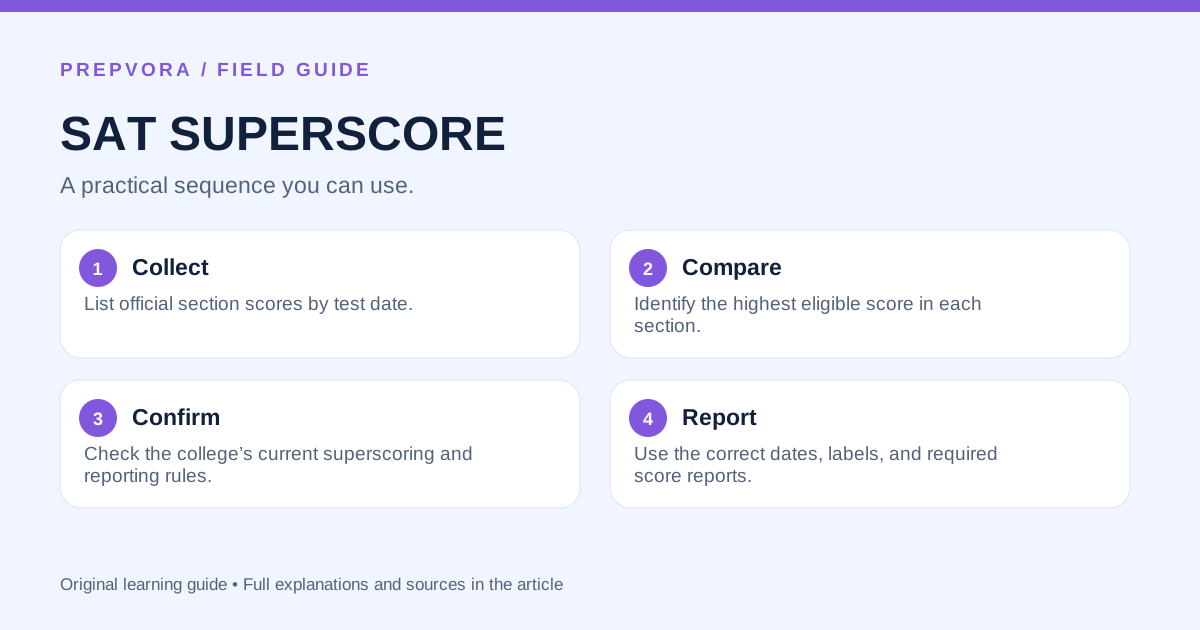
Collect
List official section scores by test date.
Compare
Identify the highest eligible score in each section.
Confirm
Check the college’s current superscoring and reporting rules.
Report
Use the correct dates, labels, and required score reports.
Sources & further reading
AI overview
The useful ideas to take with you.
- An SAT superscore combines the best eligible Reading and Writing and Math scores across dates.
- A superscore, a highest single-test total, and Score Choice are different concepts.
- Verify each college’s policy and reporting instructions before sending scores or planning another test.
AI-assisted summary, saved with this article. Use the full guide for context. Confirm current exam and college policies with the official source.
Find your next step.
A diagnostic helps you identify where to focus your practice.