
Read the full guide, explore the visual map, or jump straight to the overview. Save your place and return whenever you need it.
Explore the visual mapYour SAT score is useful when it helps you make a decision: what to study, whether to retest, or how to complete a college application. This guide explains the score scale, the latest national average, where to find your official report, and how to turn the numbers into a practical plan.
Start with the three numbers that matter
The SAT total ranges from 400 to 1600. Reading and Writing and Math each range from 200 to 800, and the two section scores add to the total. For example, 610 in Reading and Writing plus 640 in Math produces 1250. This is a fictional example, not a predicted result.
College Board’s score interpretation guide also explains score ranges and comparison groups. A percentile describes your position relative to a specified group; it is not the percentage of questions you answered correctly. Always read the label next to the percentile before comparing reports.
What is the average SAT score in 2026?
The 2026 Total Group Annual Report gives a mean total score of 1045 for the class of 2026 students who took the SAT during high school. The section means are 528 for Reading and Writing and 517 for Math. This population contains 1,954,833 test takers; it is not every graduating student in the country.
| Class of 2026 measure | Reported score |
|---|---|
| Mean total | 1045 |
| Mean Reading and Writing | 528 |
| Mean Math | 517 |
| Median total | 1030 |
The mean and median are different statistics. The mean averages the scores; the median marks the middle of the distribution. Neither is an admission requirement. Use the national figure for broad context, then research the specific colleges and programs that matter to you.
What counts as a good score?
A useful target depends on your starting point and intended use. A score that represents major personal progress may still leave room to prepare for a particular program. A high national percentile does not guarantee admission. Similarly, a score below a college’s published range is not enough information by itself to predict an application outcome.
When reading a college profile, identify the year and the population. Is the range for admitted students or enrolled students? Does it describe only students who submitted scores? Is it university-wide or specific to a program? Comparing unlike groups can make a seemingly precise comparison misleading.
Create a short college worksheet with the current testing policy, source link, score information, and deadline. Use it to choose a working target, then revisit that target after you have evidence from practice. Avoid constantly moving the goal because you saw another student’s score online.
Where to find My SAT scores
Start with College Board’s score access page and select the assessment you took. Sign in using your own College Board account. Check that the test date and assessment name match what you expect before interpreting or sharing a report. SAT Weekend, SAT School Day, and PSAT results are related but are not interchangeable records.
Download a copy for your records if that option is available. Store it privately rather than posting a screenshot containing account information. If you are working with a counselor, share the relevant scores and goals through the method your school uses. A tutor does not need your account password to help plan practice.
Why scores may not appear yet
First compare your test date with the official release calendar. For example, the November 7, 2026 SAT Weekend administration has a scheduled November 20 release. School-day release schedules work differently, so do not use a weekend table for a school administration.
Next, check whether you are signed into the account associated with your testing information. If your identity details or records do not match, use official support rather than repeatedly creating new accounts. Write down the test date, registration information you have, and the exact issue before contacting support. That makes the request easier to understand.
A missing result is not evidence of a particular score. Avoid refreshing every few minutes or assuming a friend’s earlier release means something went wrong with yours. Set a reasonable time to check again and continue with tasks you can control.
Read sections before judging the total
Two students can have the same total with very different study needs. Imagine one has 700 Math and 550 Reading and Writing; another has 620 Math and 630 Reading and Writing. Both total 1250. The first might begin with reading and grammar foundations. The second may need a balanced review of specific weaknesses.
Even a section total is only a starting point. Use available skill information and fresh practice to identify causes. A low result could reflect a concept gap, a recurring reading error, rushed decisions, or difficulty sustaining concentration. “Study more math” is too broad to tell you what to do tomorrow.
Build a two-week experiment
Choose two specific skills that repeatedly caused problems. Define an action for each: review one explanation, solve a small fresh set, and explain the method without notes. Record accuracy and whether you needed help. After several sessions, test the skills in a mixed set where the topic is not announced.
| Observation | Practice response | What to check later |
|---|---|---|
| Misread what the question asks | Restate the task before solving | Fewer answers to the wrong quantity |
| Cannot start an equation | Practice translating words into relationships | Independent setup on a new example |
| Correct but very slow | Compare two valid methods | Reliable completion within a set |
These are study experiments, not promised score gains. Keep what helps and revise what does not. A score change on one practice test should be interpreted alongside your question-level work and testing conditions.
Retesting and sending scores are separate decisions
Before retesting, identify what will change between attempts. More time is only useful if it supports better preparation or a better testing situation. Check upcoming dates, costs, school workload, and application deadlines. You may decide that another attempt is worthwhile; you may also decide your time is better spent elsewhere.
Before sending, read each institution’s current policy. Some application processes accept self-reported information initially, while others require an official report. Our score-sending guide explains the difference between selecting a test date, ordering a report, and a college receiving it.
Common score questions
Does a predicted practice score count as an official score?
No. A preparation-platform estimate helps guide studying. Use your College Board report for official SAT results and follow the recipient’s instructions when reporting them.
Can I convert every missed question into a fixed number of points?
Do not build your plan around a universal points-per-question shortcut. Focus on the skills and decisions you can improve, and use the result from the actual scored assessment.
What should I record today?
Write your total, both section scores, the test date, and two concrete next actions. That small record is more useful than labeling yourself a “good” or “bad” test taker.
SAT Scores Explained at a glance
A map of this article. Follow the ideas in order, or revisit the one you need.
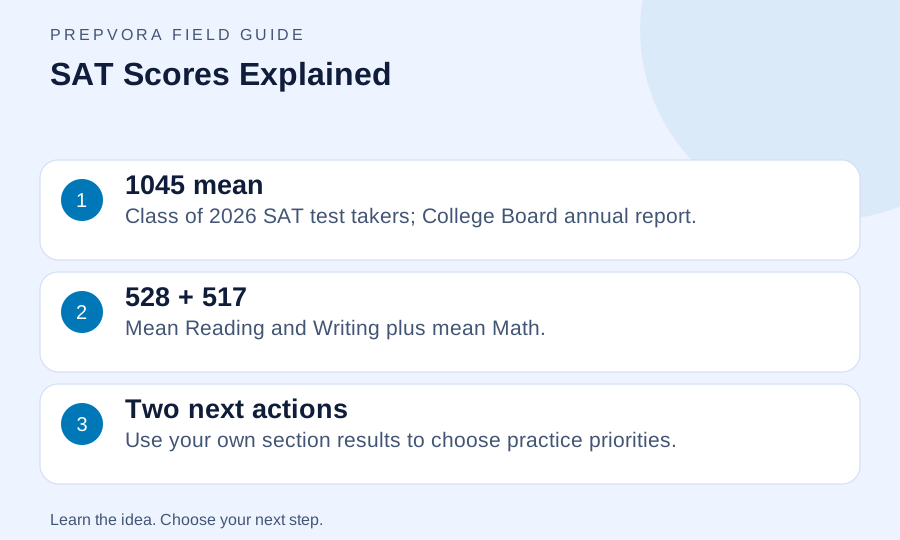
1045 mean
Class of 2026 SAT test takers; College Board annual report.
528 + 517
Mean Reading and Writing plus mean Math.
Two next actions
Use your own section results to choose practice priorities.
Sources & further reading
AI overview
The useful ideas to take with you.
- The class of 2026 SAT test-taker mean was 1045; that is context, not a college cutoff.
- Read the total, section scores, and comparison-group labels together.
- Use the official account for scores and choose specific skills before deciding whether to retest.
AI-assisted summary, saved with this article. Use the full guide for context. Confirm current exam and college policies with the official source.
Find your next step.
A diagnostic helps you identify where to focus your practice.