
If you searched for an ACT score calculator, first check which numbers you have. Section scores on the 1–36 scale can be averaged. Counts of correct answers need a test-specific conversion first. Mixing those two types of numbers produces a plausible-looking answer that does not describe your score.
The enhanced ACT formula
According to ACT’s score explanation, the enhanced Composite uses English, Math, and Reading. Add those three scaled scores, divide by three, and round to the nearest whole number. Fractions below one-half round down; fractions of one-half or more round up. Science and Writing do not enter this calculation.
Composite = round((English + Math + Reading) ÷ 3).
Use the Prepvora ACT score calculator for a quick estimate, then check the reasoning here. A preparation tool does not replace your official report in MyACT. Its value is helping you understand the arithmetic and explore practice goals.
Three worked examples
All scores in this table are fictional. They illustrate the calculation rather than a predicted result for any student.
| English / Math / Reading | Sum and average | Composite |
|---|---|---|
| 28 / 25 / 30 | 83 ÷ 3 = 27.67 | 28 |
| 26 / 25 / 28 | 79 ÷ 3 = 26.33 | 26 |
| 30 / 30 / 30 | 90 ÷ 3 = 30 | 30 |
In the first example, the average is closer to 28 than 27. In the second, it is closer to 26 than 27. Round the final average, not each intermediate operation. The three section scores are already whole-number scaled scores.
A useful arithmetic check is that the average must lie between the lowest and highest section scores. If your result falls outside that range, look for a missing section, an incorrect divisor, or raw counts entered where scaled scores belong.
Why one section point may not change the Composite
Consider section scores of 27, 27, and 27. Their sum is 81, so the Composite is 27. Raising one section to 28 makes the sum 82 and the average 27.33, still rounded to 27. Raising that section to 29 makes the sum 83 and the average 27.67, which rounds to 28.
The first improvement still matters: the section score increased even though the rounded Composite did not. Avoid treating a flat Composite as proof that no learning occurred. Section scores, error patterns, and timing observations can show changes the rounded total hides.
This arithmetic also explains why a target needs a section plan. “I need one more Composite point” does not specify a single raw question or an identical increase in every section. The relationship between correct answers and scaled scores depends on the test form.
Raw scores are not scaled scores
A raw score counts correct scored answers. A scaled score places that performance on the reporting scale. ACT’s official practice scoring key provides the conversions for its corresponding practice test. Use the key that belongs to the exact form you completed.
Suppose your practice record says “35 correct in English.” Do not enter 35 as an English scaled score unless the matching conversion table actually yields 35. One number is an answer count and the other is a position on the 1–36 scale. They may look similar while meaning different things.
Keep the test name or form identifier beside your results. Record the raw count, the converted section score, and the scoring-key source. That small habit prevents an old answer key or a mismatched online chart from contaminating your progress history.
Where Science fits
Science can still matter even though it is outside the enhanced Composite. ACT reports Science separately and uses Math and Science for its STEM score when applicable. School-day arrangements and college or program requirements can affect whether you should or must take Science. Check the instructions for your administration and the institutions on your list.
Do not add a strong Science score to the three-section total just because it raises the average. Do not omit it from an older four-section report and present the recalculation as that test’s official original Composite. A report’s format and administration date matter; use the reported number for official application tasks unless the application explicitly requests something else.
Composite and superscore answer different questions
A single-test Composite describes one administration. A superscore combines eligible highest section scores across test dates. ACT’s current superscore guide explains its three-section method and the supporting test information included with a report.
For example, imagine Test A has English 29, Math 25, and Reading 28; Test B has English 27, Math 29, and Reading 27. The single-test averages are 27.33 and 27.67, producing Composites of 27 and 28. Taking the highest score in each column gives 29, 29, and 28. Their average is 28.67, producing a superscore of 29.
That 29 is not the score earned on either individual test date. Label it correctly and verify that a college accepts superscores. Do not replace an official single-date score in an application field that asks for a particular administration.
A practical score-review worksheet
Make a row for each practice or official test. Include the date, version, scoring-key source, scaled section scores, rounded Composite, and two priority skills. Keep official results distinct from unofficial practice estimates so a college application cannot accidentally use the wrong number.
Then choose an action from the evidence. If Math is consistently lower, inspect the missed skills rather than assuming every topic needs equal time. If Reading errors cluster at the end, investigate pacing and fatigue. A calculator can summarize performance; it cannot tell you why the errors occurred without that review.
Common calculation questions
Can I use a percentage-correct average?
No. Percentages from different sections are not the scaled scores used in the Composite formula. Convert each section with the appropriate scoring key first.
Does a higher practice Composite guarantee the same official score?
No. Practice conditions, question familiarity, form differences, and test-day performance all matter. Use several fresh practice results to judge progress and reserve official reporting for official scores.
Where should I start if I have not tested yet?
Review the ACT format and MyACT guide, then take an appropriate diagnostic. Record the version before scoring it, and schedule time to review the result.
Calculate without mixing score types
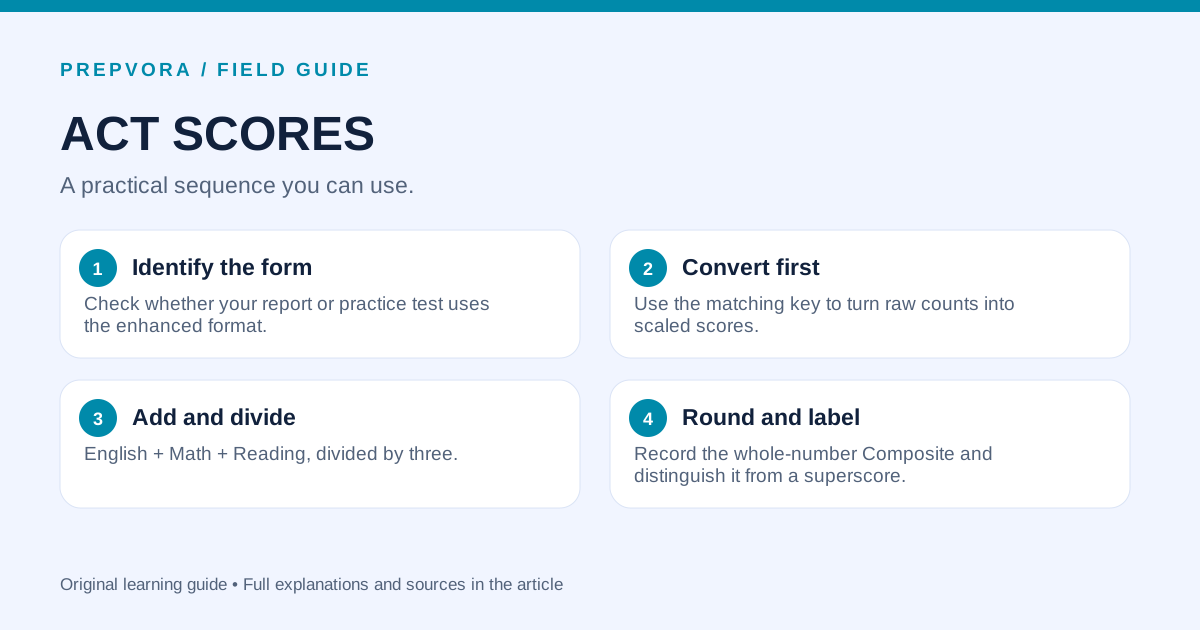
A map of this article. Follow the ideas in order, or revisit the one you need.
Identify the form
Check whether your report or practice test uses the enhanced format.
Convert first
Use the matching key to turn raw counts into scaled scores.
Add and divide
English + Math + Reading, divided by three.
Round and label
Record the whole-number Composite and distinguish it from a superscore.
Sources & further reading
AI overview
The useful ideas to take with you.
- The enhanced ACT Composite averages scaled English, Math, and Reading scores.
- Convert raw practice results with the key for that exact test before calculating the Composite.
- A superscore combines section highs across dates; a single-test Composite describes one administration.
AI-assisted summary, saved with this article. Use the full guide for context. Confirm current exam and college policies with the official source.
Find your next step.
A diagnostic helps you identify where to focus your practice.