
Expression of Ideas questions ask you to make writing work better. You may need to connect two ideas or turn notes into a sentence that accomplishes a specific purpose. This guide gives you a method for both tasks, with original examples you can solve before reading the explanation.
Recognize the two main question types
College Board’s question-bank guide identifies transitions and rhetorical synthesis within Expression of Ideas. These tasks are about relationships and purpose. They differ from grammar questions, which focus on whether a sentence follows the conventions of written English.
A grammatically polished answer can still be wrong. It may describe the wrong comparison, reverse cause and effect, or include a true fact that does not answer the requested goal. Your job is to explain why a choice fits this passage, not why the sentence would work somewhere else.
For transitions, predict the relationship first
Read the sentence before the blank and the sentence containing it. Reduce each to a short idea. Then describe their relationship in ordinary language before looking for a transition word. Useful relationships include contrast, cause and effect, example, continuation, and sequence.
Consider: “The first prototype was lightweight. The second weighed twice as much.” The relationship is contrast. “However” or “by contrast” may fit depending on the full sentence. “Therefore” would imply that the first prototype’s light weight caused the second prototype’s weight, which the information does not establish.
Prediction matters because familiar words can distract you. If you decide the connection before comparing choices, you have a standard against which to test them. You can reject an elegant word that expresses the wrong relationship.
A transition reference you can use
Use this table as a set of meanings, not as a rule that every listed word is interchangeable. Grammar and the precise context still matter.
| Relationship | Possible signals | Question to ask |
|---|---|---|
| Contrast or limitation | However; nevertheless; by contrast | Does the new idea differ from or qualify the first? |
| Result | Therefore; consequently; as a result | Does the second idea follow because of the first? |
| Example | For example; for instance | Does a specific case illustrate a broader claim? |
| Addition | Moreover; furthermore | Does this add a related supporting point? |
| Sequence | Next; subsequently | Is the relationship primarily one of order or time? |
Two events occurring in sequence do not necessarily establish causation. “The exhibit opened in May. Attendance increased in June” gives an order; you need additional context before claiming that the opening caused the increase. This distinction helps when both a time word and a result word appear among the choices.
Original transition practice
These short questions are written for this guide and are not official SAT items. Cover the explanation until you have named the relationship.
1. The team expected the coating to dissolve in water. ___, it remained intact after a week underwater.
A. Consequently B. For instance C. However D. Similarly
Answer and explanation
C: However. The result contradicts the expectation. It is neither an example of dissolving nor a similar outcome. Consequently would incorrectly present the actual result as following from the expectation.
2. Several plants in the greenhouse store water in thick leaves. ___, the jade plant retains moisture in its fleshy leaves.
A. For example B. Nevertheless C. Instead D. In contrast
Answer and explanation
A: For example. The jade plant is a specific illustration of the broader statement. No opposition or replacement is present.
For rhetorical synthesis, read the goal first
A notes question usually supplies more information than one sentence needs. Before sorting the facts, identify the task: introduce an unfamiliar subject, emphasize a similarity, describe a difference, or support a claim. Turn that goal into a short checklist.
If the question asks for a contrast in completion dates, your answer needs both items and their different dates. An answer describing their shared location may be accurate but irrelevant. Reading every fact with equal attention can make the task feel harder than it is.
Do not assume that the longest choice is most complete. Extra details may conceal a missing goal or introduce an unsupported inference. A concise answer can be sufficient when it includes exactly the relationship the prompt requests.
Original rhetorical synthesis practice
The following fictional notes describe two community projects:
- Maple Garden opened in 2018.
- Maple Garden contains 24 planting beds.
- River Garden opened in 2022.
- River Garden contains 24 planting beds.
- Both gardens are maintained by volunteers.
Goal: Emphasize a similarity in the gardens’ physical layout. Which sentence best accomplishes it?
- Maple Garden opened four years before River Garden.
- Maple Garden and River Garden each contain 24 planting beds.
- Volunteers maintain both gardens throughout the year.
- River Garden opened in 2022 and therefore has a more efficient layout.
Answer and explanation
B. The shared number of planting beds directly addresses physical layout. A emphasizes a difference. C addresses maintenance, adds “throughout the year,” and misses the layout goal. D invents a claim about efficiency that the notes do not support.
Notice how the goal changes the correct content. If the task instead asked you to describe when the gardens opened, A would become relevant. Do not memorize one “good sentence” independently of the question it answers.
Use a three-part answer check
Before selecting an answer, ask: Is it supported? Does it address the exact goal? Does it preserve the correct relationship? This catches three different errors. A statement can be true but off task, on topic but unsupported, or built from accurate details connected in the wrong way.
For a transition, replace the answer with a plain-language bridge such as “in contrast” or “as one example.” For synthesis, point to the particular note that supports each factual claim. If you cannot identify support, do not rescue the choice by adding information from outside the passage.
Turn practice into a useful error log
Record the relationship you predicted, the relationship expressed by your chosen answer, and the evidence you missed. “Vocabulary mistake” is too broad if you knew the word but misunderstood cause and effect. “Ignored the comparison goal” gives you something concrete to change on the next set.
Practice a few questions of one type, review them, then mix types so you must identify the task yourself. Return later with fresh examples. Start with the Expression of Ideas guide; use the grammar practice guide when the choices test sentence correctness instead of rhetorical purpose.
From passage to a purposeful answer
A map of this article. Follow the ideas in order, or revisit the one you need.
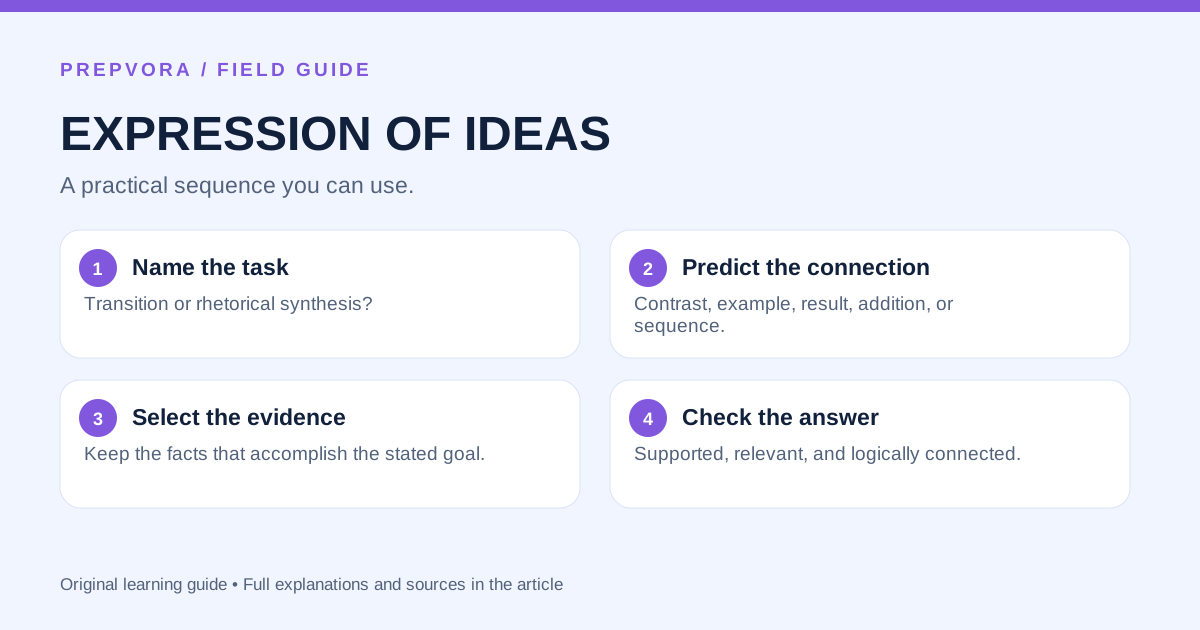
Name the task
Transition or rhetorical synthesis?
Predict the connection
Contrast, example, result, addition, or sequence.
Select the evidence
Keep the facts that accomplish the stated goal.
Check the answer
Supported, relevant, and logically connected.
Sources & further reading
AI overview
The useful ideas to take with you.
- Predict a transition’s relationship before choosing a familiar word.
- For synthesis questions, read the requested goal and select only relevant, supported facts.
- Check support, purpose, and logical relationship before committing to an answer.
AI-assisted summary, saved with this article. Use the full guide for context. Confirm current exam and college policies with the official source.
Find your next step.
A diagnostic helps you identify where to focus your practice.