
SAT grammar becomes more manageable when you replace “this sounds right” with a rule you can test. This guide walks through seven useful patterns, then gives you original practice questions with explanations. Use it beside your error log: the goal is to recognize a sentence’s structure even when its topic is unfamiliar.
What Standard English Conventions covers
College Board groups sentence structure, usage, and punctuation under Standard English Conventions. Its question bank distinguishes Boundaries from Form, Structure, and Sense. The first often changes punctuation; the second often changes words or grammatical structure. Recognizing that difference helps you decide what to inspect.
Do not read an entire question the same way every time. If the choices differ mainly in commas and semicolons, locate the clauses. If they differ between “is” and “are,” locate the subject. This is a way to direct attention, not permission to ignore context: tense and meaning may depend on nearby sentences.
1. Separate complete sentences correctly
An independent clause can stand as a sentence. It normally has a subject, a finite verb, and a complete thought. “The researchers compared the samples” passes that test. “Although the researchers compared the samples” does not; although creates a dependency that needs a main clause.
Compare these two complete ideas: “The first sample was unstable” and “the second remained intact.” A period or semicolon can separate them. A comma alone creates a comma splice. A comma plus a coordinating conjunction also works: “The first sample was unstable, but the second remained intact.”
A quick check is to read each side independently. Do not add a semicolon simply because the sentence feels long. Length does not determine whether a clause is complete.
2. Use colons and paired punctuation deliberately
A colon can introduce an explanation or list after a complete clause: “The team packed three tools: a compass, a ruler, and a stopwatch.” Avoid inserting a colon between a verb and its required object: “The team packed: a compass” interrupts the sentence unnecessarily.
Nonessential interruptions need matching boundaries. In “The bridge, completed in 1910, remains open,” the middle phrase can be removed without breaking the main sentence. If one comma opens that interruption, another closes it. Paired dashes can also set off an interruption, but mixing an opening comma with a closing dash is usually a warning sign in this construction.
3. Match the verb to the real subject
In “The collection of rare maps is available,” the subject is collection, not maps. Cross out the intervening phrase mentally: “The collection is available.” A nearby plural noun should not pull the verb away from its singular subject.
Try the reverse: “The maps in the collection are available.” Now maps is the subject. The point is not to memorize a particular phrase; it is to find the noun that controls the verb. When reviewing an error, underline that noun and explain why the distractor noun does not control agreement.
4. Keep tense tied to the timeline
Time clues help you choose a verb. “Last winter, the team collected samples” uses a past event. “Every winter, the team collects samples” describes a recurring action. Neither tense is better in isolation; the surrounding timeline determines the choice.
Do not automatically change every verb to the same tense. A passage can reasonably explain that an astronomer discovered a planet in the past and that the planet orbits a star now. Ask whether the time relationship is coherent, rather than demanding mechanical uniformity.
5. Put modifiers beside what they describe
“Walking toward the observatory, Maya noticed a bright meteor” makes Maya the walker. “Walking toward the observatory, a bright meteor appeared” incorrectly attaches the opening action to the meteor. After an introductory modifier, check the subject of the main clause.
This check works even when the sentence contains unfamiliar vocabulary. Name the actor in plain words: who walked, who measured, who designed? Then find the answer that makes that actor grammatically responsible.
6. Distinguish possession from number
“The student’s notebook” belongs to one student. “The students’ notebooks” belong to multiple students. “The students wrote notes” contains a simple plural, with no possession. An apostrophe does not mean “more than one.”
Its and it’s are a separate frequent trap. Its is possessive; it’s expands to it is or it has. Substitute the expanded phrase in context. “The telescope changed it is position” fails, so “its position” is appropriate.
7. Keep parallel items in the same grammatical form
“The project involves collecting data, comparing results, and writing a report” uses three matching -ing phrases. “Collecting data, to compare results, and a report” mixes structures without a reason. Find the beginning of each list item before choosing a replacement.
Parallelism is about grammatical roles, not identical word lengths. A long item can still match a short one. Reading the list without its extra details can make the pattern easier to see.
Original SAT-style grammar practice
These are Prepvora teaching examples, not College Board questions. Choose an answer before opening each explanation.
1. The archive of handwritten letters ___ open to researchers.
A. are B. is C. were D. have been
Answer and explanation
B: is. Archive is the singular subject. “Of handwritten letters” describes the archive; letters does not control the verb. All other options use plural agreement.
2. The experiment required patience___ each trial lasted six hours.
A. , B. ; C. and D. no punctuation
Answer and explanation
B: semicolon. Each side is a complete clause. A comma alone creates a splice; no punctuation creates a run-on. In this sentence, a coordinating conjunction would need a comma before it.
3. After reviewing the measurements, ___.
A. the report was revised by Nora B. Nora revised the report C. several errors appeared D. the measurements seemed clearer
Answer and explanation
B. Nora reviewed the measurements, so Nora should follow the introductory modifier. The other options make a report, errors, or measurements the grammatical reviewer.
Make a short review routine
Choose one rule, answer a small mixed set, and label every miss by its cause. Include correct answers you guessed. Write a fresh sentence using the same structure, then revisit the skill later without the explanation open. That transfer check is more informative than immediately repeating a remembered answer.
Use the Standard English Conventions guide and mini drill for a next step. When you switch to Expression of Ideas, change the question you ask: a sentence can be grammatical yet fail to connect ideas or accomplish a stated goal.
A seven-rule grammar check
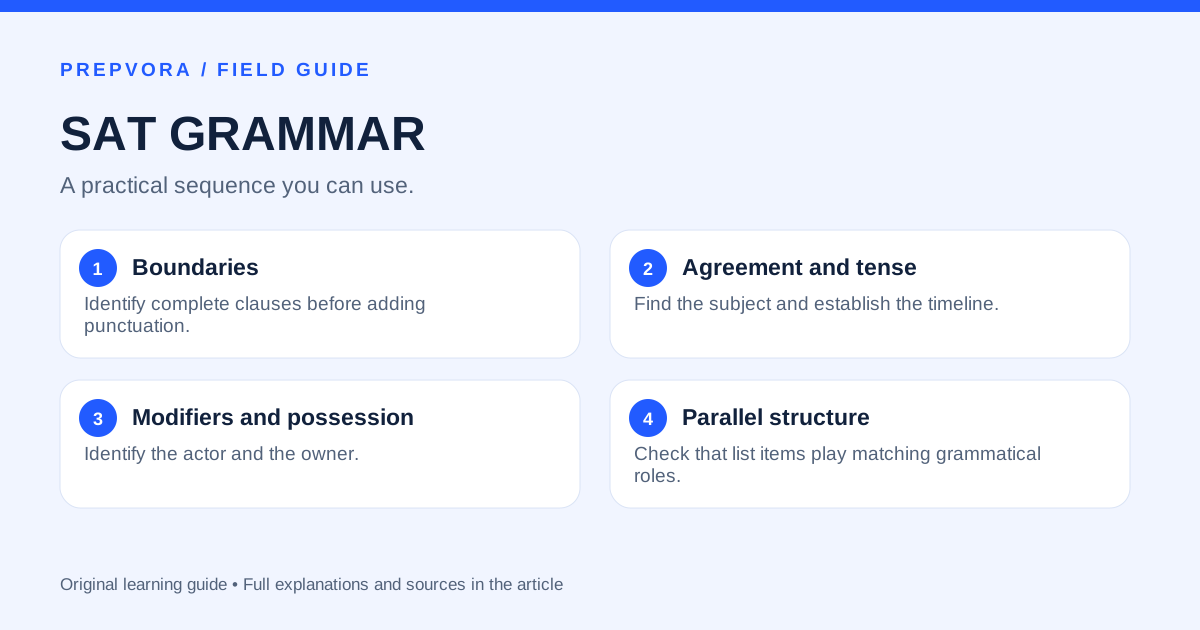
A map of this article. Follow the ideas in order, or revisit the one you need.
Boundaries
Identify complete clauses before adding punctuation.
Agreement and tense
Find the subject and establish the timeline.
Modifiers and possession
Identify the actor and the owner.
Parallel structure
Check that list items play matching grammatical roles.
Sources & further reading
AI overview
The useful ideas to take with you.
- Classify the grammar decision before comparing answer choices.
- Find complete clauses and the true subject; do not rely only on how a sentence sounds.
- Review each error with a new example so you test understanding instead of memory.
AI-assisted summary, saved with this article. Use the full guide for context. Confirm current exam and college policies with the official source.
Find your next step.
A diagnostic helps you identify where to focus your practice.