
Read the full guide, explore the visual map, or jump straight to the overview. Save your place and return whenever you need it.
Explore the visual mapA PSAT result can help you understand your current skills and choose what to practice before the SAT. The first step is identifying which assessment you took: PSAT/NMSQT, PSAT 10, or PSAT 8/9. They belong to the same assessment family, but their score ranges and purposes are not identical.
Know which PSAT is on your report
Read the assessment name and administration date before comparing numbers with a friend. College Board’s score guide lists PSAT/NMSQT and PSAT 10 totals from 320 to 1520, while PSAT 8/9 totals range from 240 to 1440. The SAT itself uses 400 to 1600.
| Assessment | Total scale | First question to ask |
|---|---|---|
| PSAT 8/9 | 240–1440 | Which foundational skills need attention? |
| PSAT 10 | 320–1520 | What does the report suggest for practice? |
| PSAT/NMSQT | 320–1520 | What are my skill needs and relevant program rules? |
Do not convert a result by multiplying it by the ratio of two maximum scores. These are assessment scales, not percentages on an assignment. Use the official interpretation and your actual skill evidence rather than inventing a formula that appears precise.
What the PSAT/NMSQT looks like
The official PSAT/NMSQT structure includes 54 Reading and Writing questions in 64 minutes and 44 Math questions in 70 minutes. The standard testing time totals two hours and fourteen minutes. Each section has two modules.
That experience gives you a useful chance to observe how you handle sustained work. Note whether errors appeared throughout the test or increased later, whether a few questions consumed disproportionate time, and whether unfamiliar tools interrupted your concentration. Those observations can guide preparation alongside the score.
How National Merit fits
College Board identifies the PSAT/NMSQT as the qualifying test for the National Merit Scholarship Program. A high total alone is not an award notification. Eligibility and program decisions involve additional rules, and students should use the current official program materials and school guidance.
Do not treat an unofficial predicted cutoff as a confirmed result. If National Merit is relevant to you, ask your counselor which materials and timelines apply to your graduation class. Keep the program question separate from the study question: regardless of recognition status, the report can still reveal useful practice priorities.
Find the official report
Start from College Board’s score-access page or the access instructions your school provides. Confirm the assessment and date. If you cannot find your record, ask the school coordinator or official support to help resolve the account match rather than repeatedly creating accounts.
When reviewing with a parent or tutor, share the relevant result privately. You do not need to post an unredacted screenshot to get study advice. Write down the two section results, the skills you want to discuss, and any testing conditions that affected the day.
Use the report as a starting point
Choose a small number of questions or skills to investigate. Suppose your Math result suggests difficulty with algebra. That label is broad. Try fresh examples involving linear equations, systems, and interpreting expressions to identify where the trouble begins.
Similarly, a Reading and Writing weakness could reflect evidence selection, vocabulary in context, sentence boundaries, or organization. Practice one skill at a time initially. Your goal is to move from “I am bad at reading” to “I need a reliable way to identify the evidence supporting an inference.”
A three-stage plan after scores arrive
| Stage | Task | Useful result |
|---|---|---|
| Understand | Read the report and note testing conditions | Two specific questions about your performance |
| Investigate | Try fresh questions in likely weak areas | A clear skill priority |
| Practice | Learn, apply, and revisit that skill | Independent success on new examples |
Keep the first week manageable. A short consistent routine is easier to sustain than a sudden schedule that competes with every school assignment. If you already have demanding coursework, coordinate preparation with topics you are learning, while still checking that you can apply them in unfamiliar problems.
Preparing for a later SAT
Once you are ready for an SAT baseline, use current-format practice and interpret that result directly. The PSAT is valuable context, but it is not a promise of your future SAT score. Skills, preparation, timing, and testing conditions can change.
Set a date for a fresh diagnostic rather than testing constantly. Between checkpoints, track behaviors you can control: completed review, independent explanations, and errors that stop recurring. This gives you evidence of progress even before the next full score report.
How parents can help
Ask what the student learned about the test, not only what number appeared. Offer practical support such as a quiet study window, help finding official information, or a weekly planning conversation. Let the student explain the next practice step in their own words.
Avoid turning a preliminary result into a prediction of college admission. It is more useful to ask, “Which skill would make next week’s practice easier?” That question keeps the focus on a concrete action rather than a label.
Frequently asked questions
Is the PSAT score my SAT score?
No. They are different assessments. Read the scale and assessment name on the report, and use an SAT assessment for an SAT result.
Does every PSAT lead to National Merit consideration?
The relevant qualifying assessment is PSAT/NMSQT, with program eligibility rules. Do not assume PSAT 10 or PSAT 8/9 serves the same purpose.
Should I start intense preparation immediately?
Start with a useful review and a manageable plan. The right intensity depends on your goals, timeline, and workload. Our practice guide offers a structure you can scale.
What is worth saving?
Keep the report, your testing observations, and a short list of next actions. Those records will make later progress easier to interpret than memory alone.
PSAT Explained at a glance
A map of this article. Follow the ideas in order, or revisit the one you need.
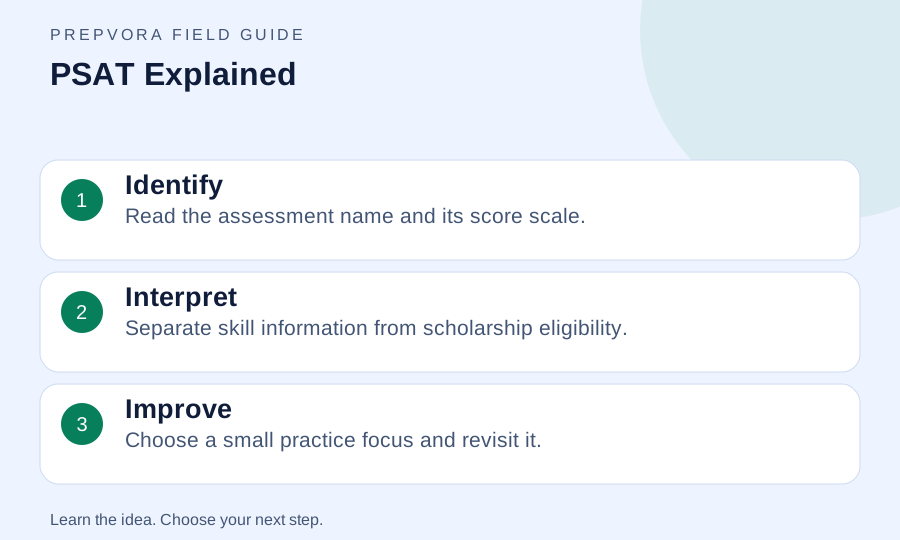
Identify
Read the assessment name and its score scale.
Interpret
Separate skill information from scholarship eligibility.
Improve
Choose a small practice focus and revisit it.
Sources & further reading
AI overview
The useful ideas to take with you.
- Identify the exact PSAT assessment before comparing score ranges.
- PSAT/NMSQT is the National Merit qualifying test; eligibility and recognition require official confirmation.
- Use the result to investigate specific skills rather than predict your future SAT score.
AI-assisted summary, saved with this article. Use the full guide for context. Confirm current exam and college policies with the official source.
Find your next step.
A diagnostic helps you identify where to focus your practice.