
Read the full guide, explore the visual map, or jump straight to the overview. Save your place and return whenever you need it.
Explore the visual mapThe SAT is a college admissions test covering reading, writing, and math. If you are starting from zero, your first job is to understand the experience, try a realistic practice test, and use the result to choose what to study. You do not need a perfect college list or an ambitious target score before answering your first question.
What the SAT measures—and what it does not
Think of the SAT as a structured opportunity to demonstrate academic skills under time constraints. Reading questions ask you to interpret evidence and ideas; writing questions ask you to recognize effective, correct expression; math questions ask you to translate and solve problems. A score describes performance on this assessment. It does not summarize your creativity, work ethic, interests, or value as a student.
Students searching “SAT meaning” sometimes get caught up in historical names. For planning purposes, use the official name SAT and focus on the current digital exam. Old paper-test advice can describe different timing and sections. The useful question is what you will actually do on the version you are registered to take.
The digital test in one table
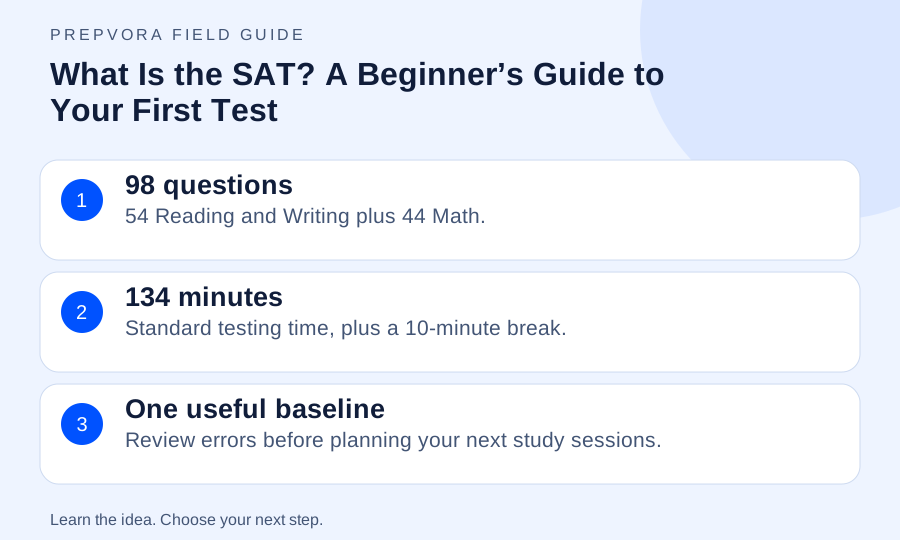
College Board’s official structure guide lists 98 questions across two sections, with 134 minutes of testing and a 10-minute break between sections. These are standard testing times; approved accommodations can change your schedule.
| Section | Questions | Standard time |
|---|---|---|
| Reading and Writing | 54 | 64 minutes: two 32-minute modules |
| Math | 44 | 70 minutes: two 35-minute modules |
Each section adapts between modules: performance in the first module informs the second module you receive. It does not change question by question. Avoid trying to infer your final score from whether one question feels easy or difficult. Your attention is more useful on the problem in front of you.
Is there an SAT science section?
There is no separate science section in the standard SAT structure. You may encounter a passage about an experiment or a question containing a graph. Approach those as reading, evidence, and mathematical reasoning tasks. Do not assume you need to memorize an entire biology textbook because a passage mentions a cell.
For example, if a chart compares plant growth under two conditions, first identify the axes, units, and groups. Then ask what comparison the question requests. “The plants grew more” and “the growth rate increased” are different claims. Reading labels carefully is often more useful than recognizing the scientific topic.
College Board, Bluebook, and My SAT: which does what?
Keep three activities separate. Your College Board account is your official account. My SAT is the official destination for SAT registration and related account tasks. Bluebook is the testing application used for digital test practice and administration. Prepvora is an independent preparation platform; a Prepvora account does not register you for an official SAT.
Start official account tasks from My SAT, rather than an unfamiliar search advertisement. Use your existing account if you have one. Keep your own recovery email accessible, record the test date you selected, and store confirmation information somewhere you can find later. Never share a password with a tutor to let them “check your score.”
Take a baseline before building a complicated plan
A baseline is useful because it replaces guesses with observations. You may feel weak at math but discover that most losses come from rushing through reading questions. Or you may understand the concepts well while spending too long on a few difficult problems. Those situations need different plans.
Use a fresh official Bluebook practice test when you want a realistic reference point. Reserve uninterrupted time, use the intended device, and follow the timing. If you need a smaller start, answer a few practice questions first—but label that activity practice, not a scored diagnostic.
Record three things after the baseline: which skills caused errors, which questions took too long, and whether fatigue changed your decisions. Do not immediately take another full test. First extract something you can change from this one. Otherwise you spend another testing session measuring the same problem.
Turn one mistake into a repeatable improvement
Suppose you miss a percentage question because you divide by the final value instead of the original value. Write the rule in your own words: percent change uses the starting quantity as its denominator. Then solve a different example with different numbers. Finally, return to the skill later without looking at the explanation.
This three-step loop—explain, apply, revisit—tests whether learning transferred. Copying an answer key feels productive but can leave the underlying mistake untouched. Your error log should be short enough to use. A skill label, a one-sentence cause, and a future review date are more helpful than pages of copied solutions.
A manageable first week
| Session | Task | Useful output |
|---|---|---|
| 1 | Explore the interface and try a few questions | Know where tools and navigation live |
| 2 | Complete a fresh diagnostic | A baseline and timing observations |
| 3 | Review errors and uncertain correct answers | Two priority skills |
| 4 | Practice those skills in short sets | A method you can explain |
| 5 | Revisit missed skills with new questions | Evidence of retention |
This is a sample schedule, not a required five-day streak. Spread it around school, work, and family commitments. If you have only a short study window, choose one complete learning task instead of opening ten resources. Consistency is easier when you know what finishing the session means.
Choose a test date after checking your real constraints
Work backward from the colleges and programs that may need your results. Separate the date you sit the test, the scheduled score release, the score-report delivery time, and the college’s own deadline. A test before an application deadline can still produce scores after that deadline. Our SAT dates planning guide walks through that distinction.
Also check school exams, transportation, available test centers, device readiness, and any accommodation arrangements. A realistic date gives you time to prepare and recover if plans change. Registering for the soonest test simply because it exists is not a study strategy.
Questions beginners ask
Do I need to choose SAT or ACT immediately?
You can compare current-format practice before committing. Choose using evidence about your performance, comfort, and logistics. Do not choose solely because a friend says one test is easier. Read our current ACT guide before comparing formats.
Should I learn every topic before practicing?
No. A short practice experience helps you identify what to learn. Alternate instruction and application so you can see whether a method works independently. Save some fresh questions for later checks.
What should I do today?
Choose one first action: explore Bluebook, try three questions, or schedule a full diagnostic. Then write down when you will review the result. The review appointment is what turns a test into a plan.
What Is the SAT? A Beginner’s Guide to Your First Test at a glance
A map of this article. Follow the ideas in order, or revisit the one you need.
98 questions
54 Reading and Writing plus 44 Math.
134 minutes
Standard testing time, plus a 10-minute break.
One useful baseline
Review errors before planning your next study sessions.
Sources & further reading
AI overview
The useful ideas to take with you.
- The SAT has Reading and Writing and Math; there is no separate standard science section.
- A full timed diagnostic and a short practice set serve different purposes.
- Use your baseline to select two skills, then explain, apply, and revisit them.
AI-assisted summary, saved with this article. Use the full guide for context. Confirm current exam and college policies with the official source.
Find your next step.
A diagnostic helps you identify where to focus your practice.