
Read the full guide, explore the visual map, or jump straight to the overview. Save your place and return whenever you need it.
Explore the visual mapThe best SAT practice routine has three jobs: find a weakness, teach you something useful, and check whether you can apply it later. Taking more tests is not automatically the same as improving. This guide gives you a practical system for choosing questions, reviewing mistakes, and deciding when another full test is worth your time.
Choose the right kind of practice
A full-length test measures how skills, pacing, and stamina work together. A focused question set isolates a topic. An untimed lesson helps you learn a method. Each is useful, but they answer different questions. If you do not understand how to set up a linear equation, another timed test is an expensive way to rediscover that gap.
College Board offers digital Bluebook practice tests and nonadaptive paper practice. Its digital practice guidance also connects students with official questions. Use current-format resources and keep track of which full tests you have already seen.
Set up a baseline you can trust
Choose an uninterrupted testing window and a fresh test. Use the device and tools you expect to use during testing. Follow the timing rather than pausing whenever a question becomes uncomfortable. If an interruption occurs, note it. That context matters when you interpret the result.
Before starting, write one prediction: what do you expect to find difficult? Afterward, compare the prediction with evidence. You may discover that the section you fear is not the main source of lost points. This simple comparison can stop you from spending weeks on comfortable review while avoiding the real issue.
Review more than the wrong answers
Mark three categories for review: wrong, correct but guessed, and correct but slow. A lucky answer can hide a concept gap. A slow correct answer can create pressure later in the module. Reviewing only red marks misses both.
| Result | Review question | Next task |
|---|---|---|
| Wrong | What caused the first incorrect step? | Learn and retry the method |
| Correct by guessing | Can I justify this independently? | Solve a fresh related example |
| Correct but slow | Is there a simpler reliable route? | Compare methods under light timing |
Do not write “careless” for every mistake. Name the behavior: copied a negative sign incorrectly, answered for the radius instead of the diameter, ignored a transition, or selected a statement stronger than the evidence. A specific cause suggests a specific correction.
Use a small error log
Your log needs only a few fields: date, skill, mistake, corrected rule, and revisit date. For a reading question, the corrected rule might be “choose what the passage supports, not what could be true.” For math, it might be “define the variable before writing the equation.”
Keep explanations short enough that you will reread them. A copied paragraph from a solution is less useful than one sentence you can explain. If you cannot explain why the right answer is right and one tempting answer is wrong, the review is not finished yet.
Build a learning session around one skill
Start with a short explanation, then solve a few examples without help. Check the work, identify the first point of confusion, and try a new problem. Finish by writing the method from memory. This is a suggested routine, not a requirement to spend a fixed number of minutes on every skill.
Suppose your topic is systems of equations. Begin by explaining what an intersection means. Solve one system algebraically, then graph a second system to verify it. Finally, translate a word problem into two equations. That sequence builds a connection among the concept, procedure, and application.
Mix skills once the foundations hold
When every question in a set announces the same topic, recognizing the method is easy. Mixed practice adds the decision of which method to use. Move into mixed sets after you can solve fresh examples of a skill reasonably independently.
Do not confuse recognition with mastery. You may recognize a question because you saw its solution yesterday. Change the numbers or context, explain why the approach still applies, and revisit it later. A method that survives those changes is more dependable than a memorized answer.
A flexible two-week plan
| Stage | Focus | Evidence to collect |
|---|---|---|
| Baseline | One realistic diagnostic | Skill and pacing observations |
| First review | Wrong, uncertain, and slow answers | Two priority skills |
| Focused sessions | Instruction plus new examples | Independent explanations |
| Mixed check | Choose methods without topic labels | Retention and timing |
| Reassessment | A fresh timed section or test | What changed and what remains |
Spread these stages around your actual commitments. If you miss a session, continue with the next useful task instead of trying to repay a growing “study debt.” An overloaded calendar can turn a workable plan into something you avoid.
Use explanations and AI deliberately
Ask for a hint before a complete solution when you are close. After reading an explanation, close it and solve the problem again. Then try a different example. The goal is to make the reasoning yours, not simply to make the page display the right answer.
AI can help restate a concept or compare methods, but check its calculations and reasoning. If a solution contradicts the question, pause and verify. Never treat confident wording as proof. For math, substitute the result into the original conditions; for reading, locate the evidence in the passage.
Know when to take another full test
Retest when you have made a meaningful change and want to measure it. That might mean several skills are more reliable, your pacing approach is different, or you have practiced completing longer sessions. Do not take a full test simply because you dislike the previous score.
Keep fresh official tests available for later checkpoints. Repeated familiar tests can still support review, but their scores are not clean evidence of new performance. Label repeat attempts in your log so you do not mistake memory for progress.
Frequently asked questions
How many questions should I do each day?
Enough to complete a learning cycle you can review. Ten thoughtfully reviewed questions can be more useful than a large rushed set. The right amount depends on the difficulty and your available time.
Can I start with only three questions?
Yes. Treat them as a low-pressure introduction, not a scored diagnostic. Use them to learn the interface and choose your next session.
What should I do when scores fluctuate?
Check testing conditions, familiarity, and skill-level evidence. Look for a pattern across comparable attempts rather than reacting to one number. Our score guide helps put results in context.
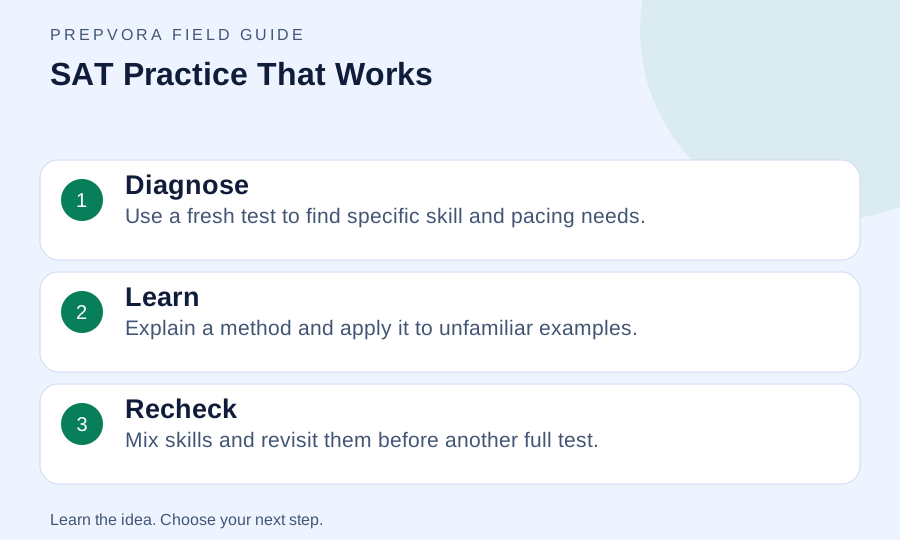
SAT Practice That Works at a glance
A map of this article. Follow the ideas in order, or revisit the one you need.
Diagnose
Use a fresh test to find specific skill and pacing needs.
Learn
Explain a method and apply it to unfamiliar examples.
Recheck
Mix skills and revisit them before another full test.
Sources & further reading
AI overview
The useful ideas to take with you.
- Use full tests for measurement and focused sets for learning.
- Review wrong, guessed, and slow answers, then name the specific cause.
- Retest after meaningful practice and preserve fresh questions for honest checkpoints.
AI-assisted summary, saved with this article. Use the full guide for context. Confirm current exam and college policies with the official source.
Find your next step.
A diagnostic helps you identify where to focus your practice.