
A college application becomes easier to manage when you separate three things: the information you provide, the requirements each college sets, and the deadlines attached to each task. Common App helps organize applications, but it does not make every institution’s rules identical. Build one clear checklist before you start submitting.
What Common App does
The official first-year guide walks through gathering information, creating an account, adding colleges, and completing requirements. You can prepare shared information such as your background, education, activities, and testing details, while colleges may also ask institution-specific questions and writing supplements.
Use your own account and an email you will continue checking. Gather records before entering details from memory. Keep a separate place for school-specific requirements so you do not assume a completed shared section means every application is ready.
Early Action, Early Decision, and Regular Decision
College Board’s application-plan guidance distinguishes nonbinding Early Action from binding Early Decision. Restrictive or single-choice early plans can add limits on other early applications. Always read the actual agreement and policy of the institution you are considering.
| Plan | General idea | What to verify |
|---|---|---|
| Early Action | Earlier consideration without the usual binding enrollment commitment | Restrictions, deadline, and reply terms |
| Early Decision | A binding first-choice application plan | Agreement, affordability, and obligations |
| Regular Decision | Consideration on the regular schedule | Materials and response deadlines |
| Rolling admission | Review over a stated period | Priority dates and availability |
Do not choose a binding plan simply because a headline suggests better odds. Think through whether the college is your clear first choice and discuss affordability and the agreement with your family and counselor. Published admission rates do not isolate the effect of applying early for an individual student.
Build one source-backed college list
For each college, record the application plan, deadline, intended program, required supplements, testing policy, recommendation requirements, and financial-aid deadlines. Add the official page link and the date you checked it. This turns a collection of browser tabs into a usable system.
Keep a balanced list based on academic fit, interests, location, support, and cost. A college name alone is not a plan. Write one sentence explaining why each institution belongs on your list; if you cannot, do more research before spending time on its application.
Handle testing correctly
Common App’s Testing section can hold self-reported scores, but the college determines whether that is sufficient. Some recipients require official reports. A testing policy can also differ by entry year or program, so use the instructions for your actual application.
Make separate checklist entries for entering accurate scores and ordering any required official report. Include the test date and section scores exactly as requested. Do not invent a combined test sitting or assume that typing a score automatically triggers a report from College Board or ACT.
Our SAT score-sending guide explains delivery stages and fees. Use the ACT guide for the current test format and official account destination. Preparation-platform estimates should not be substituted for official exam results.
Give recommenders a useful request
Ask early enough for a thoughtful response and follow your school’s process. Tell the recommender which programs you are applying to, the earliest deadline, and what information would help them. A concise summary of work you did together is more useful than asking for a generic “strong letter.”
Track whether the invitation was accepted and whether the required material was submitted, without repeatedly pressuring the person. Your school may have its own internal deadlines that occur before the college’s deadline. Record those separately so they do not disappear behind the later date.
Write with evidence and specificity
When describing an activity, explain what you actually did and what changed because of your contribution. “Helped a club” is vague. A concrete description of organizing meetings, solving a problem, or maintaining a project gives a reader something to understand.
For essays, answer the actual prompt before polishing style. Keep your experiences and voice accurate. Feedback can help you clarify meaning, but it should not turn your writing into someone else’s biography. Do not invent accomplishments or inflate roles to make an application sound more impressive.
Run a pre-submission check
- Confirm the college, program, entry term, and application plan.
- Review names, dates, school information, and testing entries.
- Read each required supplement and confirm it answers the right prompt.
- Check recommendation and transcript arrangements.
- Review the application preview for formatting and omissions.
- Confirm any fee or waiver step and save submission confirmation.
Work through the checklist slowly enough to catch copy-and-paste mistakes. A polished paragraph addressed to the wrong institution is still an error. Check the final version actually being submitted, not only the document where you drafted it.
After submission, use the applicant portal
Follow the college’s instructions for its applicant portal and monitor the materials checklist. Submission of the application and receipt of every supporting item may happen at different times. Allow the institution’s stated processing window before treating a missing checklist item as a failure.
If something remains missing, send a concise inquiry with your identifying application information through the official channel. State what you submitted, when, and what the portal shows. Do not send unnecessary sensitive documents or repeat an order before checking the existing one.
Keep financial-aid tasks on their own timeline
Admission and financial aid are related but separate workflows. Record the required forms and deadlines from each college’s financial-aid office. An application submitted on time does not automatically mean every aid requirement is complete.
Discuss affordability before decisions arrive. Use official college resources and your family’s circumstances rather than assuming that an advertised price or someone else’s award will match your situation. Keep questions for the aid office specific and save the answers.
Frequently asked questions
Does Early Action always have the same rules?
No. Check whether the plan is restrictive and how it interacts with applications elsewhere. The plan’s name is not enough information.
Can I finish all applications with one shared essay?
Some shared material can be reused, but colleges may require additional responses. Check each institution’s requirements in the application.
What should I do first?
Complete one accurate college checklist row using official sources. Then repeat the process for the rest of your list. Clear requirements make writing and submission much less chaotic.
Common App and Early Action at a glance
A map of this article. Follow the ideas in order, or revisit the one you need.
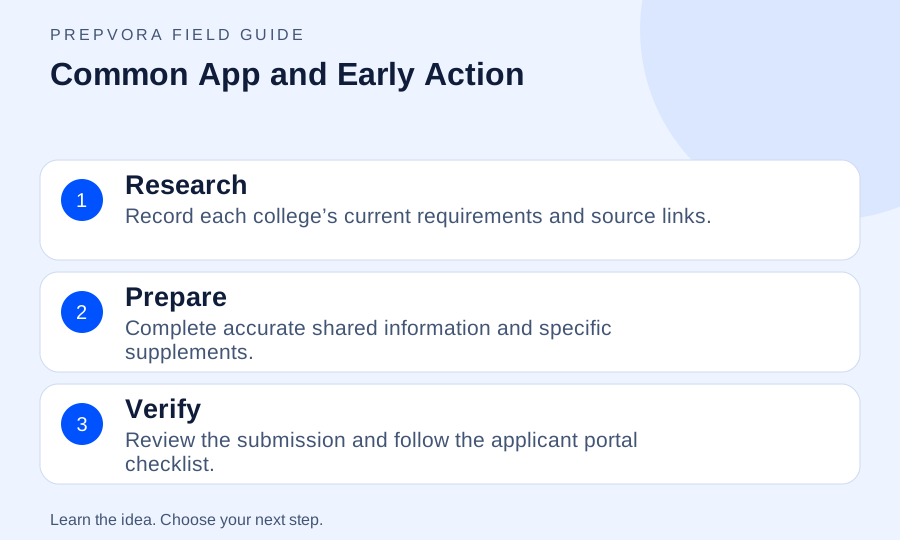
Research
Record each college’s current requirements and source links.
Prepare
Complete accurate shared information and specific supplements.
Verify
Review the submission and follow the applicant portal checklist.
Sources & further reading
AI overview
The useful ideas to take with you.
- Common App organizes applications; colleges still set their own requirements.
- Understand binding and restrictive terms before choosing an early plan.
- Track testing, supporting documents, submission, and financial aid as separate tasks.
AI-assisted summary, saved with this article. Use the full guide for context. Confirm current exam and college policies with the official source.
Find your next step.
A diagnostic helps you identify where to focus your practice.