
Read the full guide, explore the visual map, or jump straight to the overview. Save your place and return whenever you need it.
Explore the visual mapIf you are applying to the University of Southern California, begin with USC’s current instructions for your entry year and major. Do not build the application around an old admissions chart. Testing choices, official reporting, application plans, and program-specific materials need to be checked together.
USC’s current testing policy
As checked October 31, 2026, USC’s test-optional FAQ says applicants choose whether to have SAT or ACT scores considered and are not penalized for choosing not to submit. For applicants choosing score consideration, USC requires official reports from the testing agency; self-reported scores are not sufficient.
This distinction matters when using Common App. Entering scores in its Testing section does not replace an official report where USC requires one. Decide how you intend to apply, then complete the reporting steps that correspond to that decision.
Do not invent a required SAT cutoff
A published score range describes a population; it is not automatically a minimum requirement or a guarantee. Before using a number, identify the year, whether it refers to admitted or enrolled students, and whether it includes only score submitters.
Your application decision should consider the full context of your preparation and the university’s stated policy. A counselor can help you interpret your record, but no blog can turn one score into a reliable personal admission probability. Avoid “safe score” promises that conceal the uncertainty of selection.
Check the plan and major together
USC’s first-year instructions currently list November 1 Early Decision and Early Action deadlines for most majors. Early Decision is binding; Early Action is nonbinding and nonrestrictive. Performing arts programs have different arrangements, including a December 1 deadline; the regular deadline for most other majors is January 10.
Use those dates as a starting point, then read the details for your intended major. Do not assume every program follows the broadest university deadline. The official page also lists exceptions and additional materials, so checking only a summary table can leave an important task undiscovered.
Build a USC-specific worksheet
| Decision | What to record |
|---|---|
| Program | Your intended major and its official requirements page |
| Application plan | The plan you choose and its terms |
| Testing | Whether scores will be considered and any report order |
| Supplemental work | Required writing, portfolio, audition, or other materials |
| School documents | Who is responsible and the school’s internal timeline |
| Follow-up | Portal checks and unresolved questions |
Keep the worksheet short enough to review weekly. Its purpose is to reveal missing actions, not to become another project. Add a named next step beside anything uncertain: “ask counselor,” “read department instructions,” or “confirm score delivery.”
If you choose to submit scores
Use the testing agency’s official service, verify the recipient, and retain the confirmation. USC’s testing FAQ advises completing standardized testing at least a month before the application date so results can be included. That is a planning instruction, not a promise that a late score will be accepted.
Check your application round before assuming the next available SAT will work. For example, a test in November releases results after a November 1 application date. If your situation is unclear, ask USC directly rather than relying on a general score-delivery estimate.
Keep three statuses separate: you ordered the report, the agency delivered it, and the university matched it to your application. Our score-sending guide explains why those stages can take different amounts of time.
If you choose not to submit scores
Follow the application’s instructions accurately and focus on completing the rest of your materials. Do not leave required fields inconsistent because you are unsure what “optional” means. Read the official FAQ and ask a specific question if your situation falls outside the published explanation.
Use your time deliberately. Finishing a thoughtful program-specific response or checking a missing school document may be more useful than repeatedly reconsidering the same testing decision. Set a point at which you will finalize the choice based on the information available.
Make program research useful for your writing
Look for concrete academic reasons a program fits your interests. Read curriculum descriptions and the opportunities the school actually offers. Then connect those details to something you have studied, built, investigated, or want to explore.
A list of famous names or generic praise for a university does not explain your fit. Specificity helps you test your own interest as well as communicate it. If you cannot explain why a program matters to you without using prestige language, spend more time on the research before drafting.
Review the application as one coherent record
Check that dates, activities, school information, and testing entries agree across materials. Read the final preview rather than assuming your draft pasted correctly. Confirm that each response addresses its prompt and that the institution’s name is correct wherever you mention it.
Ask a trusted reader to flag unclear passages and inconsistencies, while keeping your experiences and voice your own. A useful review identifies a problem you can fix; it does not replace your account with embellished achievements or a generic polished persona.
After you submit
Follow USC’s instructions for the applicant portal and any subsequent tasks. Keep submission confirmation and relevant correspondence together. Check the portal on a reasonable schedule instead of treating every pending item as an emergency.
If an item remains unresolved beyond the stated processing guidance, contact the appropriate office with a concise description. Include the application context they need, but do not send passwords or unnecessary private records. Save the response and update your worksheet so the issue does not get lost.
Frequently asked questions
Does test-optional mean self-reporting is enough?
No. USC’s current policy requires official reports if you choose to have SAT or ACT scores considered.
Can I use one deadline for every USC major?
No. Check the intended program and application plan. Major-specific requirements can change the schedule.
Is this the same as applying to another university called USC?
No. This guide concerns the University of Southern California. Verify the full institution name when researching or sending scores.
What should I do now?
Open the official first-year page, identify your major and plan, and write down the next incomplete requirement. That action is more useful than searching for a guaranteed admission formula.
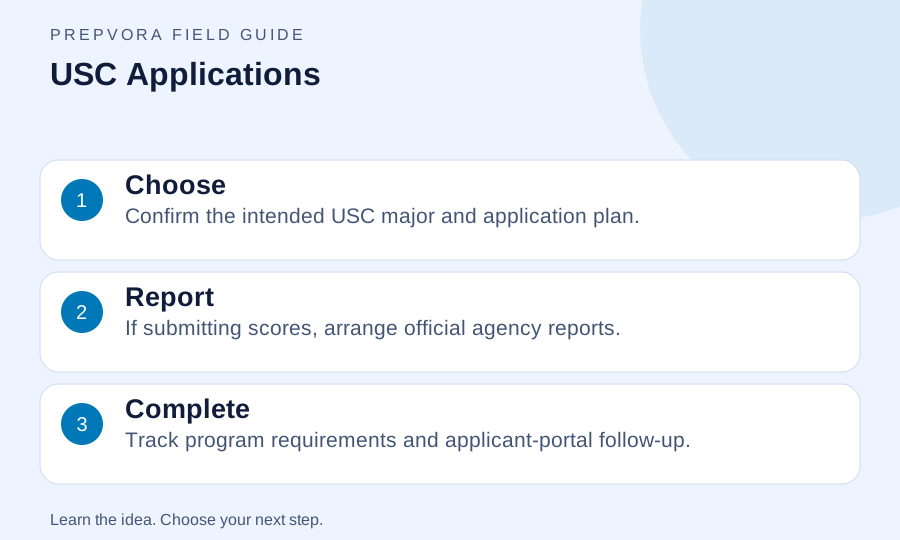
USC Applications at a glance
A map of this article. Follow the ideas in order, or revisit the one you need.
Choose
Confirm the intended USC major and application plan.
Report
If submitting scores, arrange official agency reports.
Complete
Track program requirements and applicant-portal follow-up.
Sources & further reading
AI overview
The useful ideas to take with you.
- This guide concerns the University of Southern California and policies checked October 31, 2026.
- USC is currently test-optional but requires official reports when applicants submit scores.
- Verify your major’s requirements and application plan rather than relying on a universal deadline.
AI-assisted summary, saved with this article. Use the full guide for context. Confirm current exam and college policies with the official source.
Find your next step.
A diagnostic helps you identify where to focus your practice.