
Read the full guide, explore the visual map, or jump straight to the overview. Save your place and return whenever you need it.
Explore the visual mapAP scores tell you how you performed on individual AP Exams. They can also support college credit or placement when a college’s policy allows it. Finding a score, sending an official report, and receiving credit are separate steps. This guide helps you move through them without assuming that one automatically completes the next.
Understand the AP scale
AP Exams use a 1–5 scale. College Board’s score-scale table describes 5 as extremely well qualified, 4 as very well qualified, 3 as qualified, 2 as possibly qualified, and 1 as no recommendation. These are recommendations about qualification for credit or placement, not a universal college-credit guarantee.
| AP score | College Board recommendation | Your next check |
|---|---|---|
| 5 | Extremely well qualified | Exact exam and college policy |
| 4 | Very well qualified | Required score and course equivalency |
| 3 | Qualified | Whether credit or placement is offered |
| 2 | Possibly qualified | Available options and future learning |
| 1 | No recommendation | Review needs without treating one result as an identity |
An AP score is not an SAT section score or an ACT Composite. Keep the exam name and reporting system clear when entering information in an application. Do not convert among these scales using a simple percentage.
Find your official AP results
Start from College Board’s AP Scores page and follow its score-access instructions. Use the account associated with your exams. Confirm the subject and year before interpreting the result or sharing it with an adviser.
If a result is missing, check official guidance about processing and account matching. A missing score is not the same as a low score. Avoid creating several accounts to search for a record; contact official support when you need help resolving the identity or exam information.
Store a private copy of the information you need. When asking for help, describe the exam, year, and issue rather than publicly posting a screenshot with personal identifiers. A counselor can often help you frame a precise support request.
Credit and placement are different outcomes
Credit can count toward a college’s academic requirements under its policy. Placement can allow you to begin at a different course level without necessarily granting the same credits. Read the wording carefully: a statement about placement is not automatically a promise of progress toward graduation.
For each college, look up the exact AP subject, minimum score, course equivalent, amount of credit, and any program restrictions. Then ask how that result applies to your intended degree. A university-wide chart may not answer every question about a particular major or sequence.
Make a credit-planning worksheet
| Field | Example of what to record |
|---|---|
| Exam | The exact AP subject and year |
| Result | Your official score |
| College rule | Current policy link and minimum score |
| Outcome | Credit, placement, both, or neither |
| Degree fit | How the result applies to your program |
| Action | Report order or adviser question |
Use this worksheet to organize questions, not to declare yourself exempt from a course before the college confirms it. Bring it to advising so the conversation can focus on your actual academic plan.
Send an official AP report when needed
College Board’s online sending instructions explain the official process. Students receive one free score send in a year they take AP Exams, subject to its selection deadline. Additional reports currently cost $15 each, as checked October 31, 2026. Verify the current fee and deadline before placing an order.
Search for the correct institution, review the recipient, and save confirmation. AP reporting is separate from SAT reporting even though both use College Board accounts. Sending an SAT report does not send your AP results, and completing a college application does not necessarily place an official AP report order.
Understand what the report includes
College Board states that AP reports generally include your AP score history, not just one selected exam. Withholding and cancellation have separate official procedures. Read those instructions carefully before requesting either action; do not assume the SAT’s Score Choice process applies to AP.
If your concern is whether a college needs an official report during admission or only later for credit, check that college’s policy first. The correct task depends on the purpose. Paying for a report before understanding the requirement can create extra work without solving the actual question.
Delivery does not mean credit has posted
After ordering, check the official report status and then the college’s records process. The college still needs to receive, match, and evaluate the result. A delivery confirmation and an updated degree audit are different milestones.
If credit has not appeared, ask the registrar or relevant advising office about its timeline and requirements. Provide the exam and order context they request. Avoid duplicate orders unless the institution or testing service identifies a reason to resend.
Choose courses thoughtfully
Even when you qualify for placement, consider how confident you feel with the material and how the next course builds on it. Ask an academic adviser about the tradeoff between advancing and reinforcing foundations. A decision that works for one major may not fit another.
Use concrete evidence in that discussion. Which topics can you explain independently? How recently did you study them? Does the next course assume techniques you have not practiced? Those questions support a better choice than treating acceleration as automatically superior.
What if your result was disappointing?
Separate the emotional reaction from the next academic decision. One exam does not erase the work you did in the course. Identify whether the difficulty came from content, timing, exam technique, or conditions on the day, then decide what learning would help next.
If you are considering another exam attempt or a different course path, weigh the purpose, preparation, cost, and available alternatives. Do not commit simply to replace a number. A teacher or adviser can help connect the result to your broader learning goals.
Frequently asked questions
Does a 3 always earn college credit?
No. Each college sets its own exam-specific policy. Check the current rule and how it applies to your program.
Are AP scores sent with SAT scores?
No. They use different official reporting workflows. Track them as separate tasks.
Can I self-report AP results in an application?
Follow the application and college instructions. Self-reporting for admission and an official report for credit are different purposes.
What should I do first?
Confirm your official results and look up the exact policy at the college where you need them considered. Then order only the report you actually need and follow through until the institution has processed it.
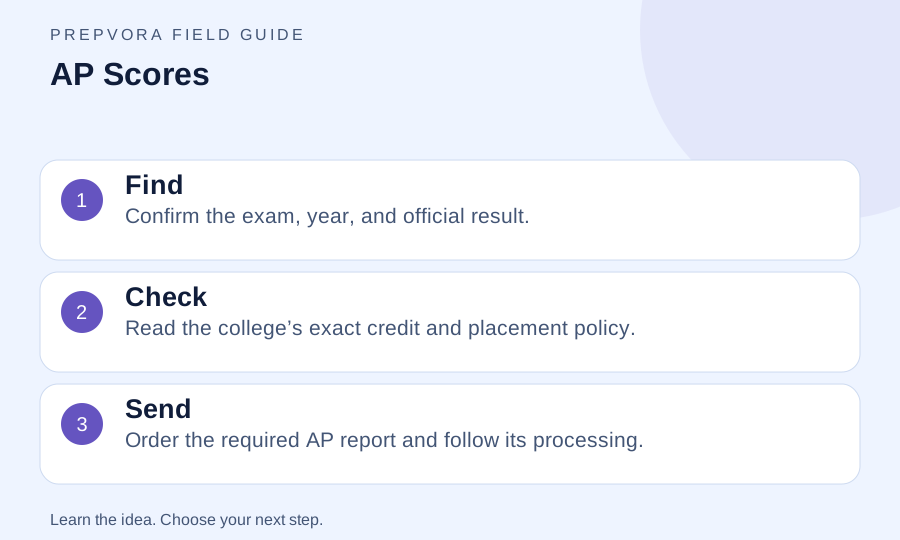
AP Scores at a glance
A map of this article. Follow the ideas in order, or revisit the one you need.
Find
Confirm the exam, year, and official result.
Check
Read the college’s exact credit and placement policy.
Send
Order the required AP report and follow its processing.
Sources & further reading
AI overview
The useful ideas to take with you.
- AP uses a 1–5 scale, but credit and placement depend on each college’s policy.
- Official AP reports are separate from SAT reports and generally include score history.
- Track delivery and college processing separately, then discuss course placement with an adviser.
AI-assisted summary, saved with this article. Use the full guide for context. Confirm current exam and college policies with the official source.
Find your next step.
A diagnostic helps you identify where to focus your practice.