
Read the full guide, explore the visual map, or jump straight to the overview. Save your place and return whenever you need it.
Explore the visual mapThe ACT has changed, so an older comparison chart may describe the wrong exam. The current enhanced ACT centers on English, Math, and Reading, with Science and Writing options that depend on your administration and choices. Start by confirming the version you will take, then use current-format practice to decide how to prepare.
The current sections and timing
ACT’s official structure guide lists the following standard timings. The core sections total 125 testing minutes, excluding breaks and any optional sections.
| Section | Questions | Minutes |
|---|---|---|
| English | 50 | 35 |
| Math | 45 | 50 |
| Reading | 36 | 40 |
| Science, when taken | 40 | 40 |
| Writing, when taken | 1 essay | 40 |
For state and district testing, Science may be selected at the contract level rather than by each individual student. ACT’s implementation guidance explains that distinction. Confirm your school’s arrangements instead of assuming an option shown for national registration applies to your school test.
How the current Composite works
The enhanced Composite uses English, Math, and Reading scores on the 1–36 scale. ACT’s score guide explains that the average is rounded to the nearest whole number. Science and Writing do not enter that enhanced Composite calculation.
For an original example, scores of 27, 25, and 29 sum to 81. Dividing by three gives a Composite of 27. This calculation illustrates the arithmetic; it does not convert raw practice answers into section scores. Use the scoring instructions that belong to the actual practice form.
When comparing an older report with a newer one, check the administration and scoring context. Do not silently apply today’s formula to a historical report and treat the result as if it were the originally issued score.
Where MyACT fits
MyACT is ACT’s official student account destination. Use it for the account tasks and results associated with your testing. A College Board login is for a different organization, and a preparation-platform login is not an official ACT registration.
Use your existing account and keep your recovery information current. Before making changes, confirm that the test date, name, and other identifying information match your registration. If you cannot access the right record, use official support rather than opening several accounts and hoping one displays the score.
When ACT scores become available
ACT publishes initial release dates and score-access guidance. Initial release means processing begins to produce available results; it is not a promise that every student receives a score at the same moment. The schedule can differ between online and paper testing.
If your result is not visible, check the appropriate administration and official guidance first. Write down the exact problem before contacting support. “My October test is missing from this account” is more actionable than “the website is broken.” Avoid sharing personal records in public score-release discussions.
Should you take Science or Writing?
Check the current expectations of your colleges, programs, and testing arrangement. Do not decide solely from a statement that a section is optional. Optional at registration and unnecessary for every possible purpose are not the same thing.
Also consider the added testing time and preparation. If a section serves a real requirement or goal, plan for it explicitly. If you are unsure, ask a counselor or the recipient with your intended entry year and program. Save the policy link and the date you checked it.
Compare SAT and ACT using evidence
Try current-format practice for each test under comparable conditions. Record not only the result but also how you handled pacing, reading load, and transitions. A preference based on one unusually familiar passage is weaker evidence than a pattern across a complete practice experience.
| Observation | What it may suggest |
|---|---|
| You know the material but run out of time | Investigate pacing and method selection |
| You finish but make many setup errors | Prioritize accuracy and interpretation |
| One format feels consistently more manageable | Consider focusing preparation there |
| Logistics differ substantially | Include access, dates, and travel in the decision |
Do not compare an untimed result on one exam with a timed result on the other. Do not use an outdated conversion chart as if it guarantees an admissions outcome. Your choice should be practical as well as academic.
A starting routine for ACT preparation
Begin with a baseline, then review incorrect, uncertain, and slow responses. In English, identify the grammatical or rhetorical reason for each choice. In Math, find the first incorrect step. In Reading, point to the evidence that supports your answer instead of relying on memory of the passage.
Choose two skills for the next few sessions. Practice them separately, then mix them with other topics so you have to recognize the method. Track whether you can explain your reasoning without a hint. This is more informative than counting completed questions alone.
Keep score reporting separate from studying
Before sending results, check each institution’s reporting instructions. An application may ask for self-reported information, an official report, or both at different stages. Use ACT’s official account process for official ACT reports; do not assume a SAT reporting instruction applies unchanged.
Maintain a small checklist with recipient, required method, deadline, order status, and confirmation. The same organization system that helps with applications can prevent unnecessary repeat orders and last-minute confusion.
Frequently asked questions
Is Science always an individual choice?
No. School-based arrangements can select it at a broader level. Confirm your administration before preparing around an assumption.
Does an optional section change the enhanced Composite?
The enhanced Composite uses English, Math, and Reading. Read your official report for the other results and their interpretation.
What is my best first step?
Confirm your test format and date, then take a fresh current-format practice assessment. Use the result to choose a manageable study focus instead of committing to a large generic plan.
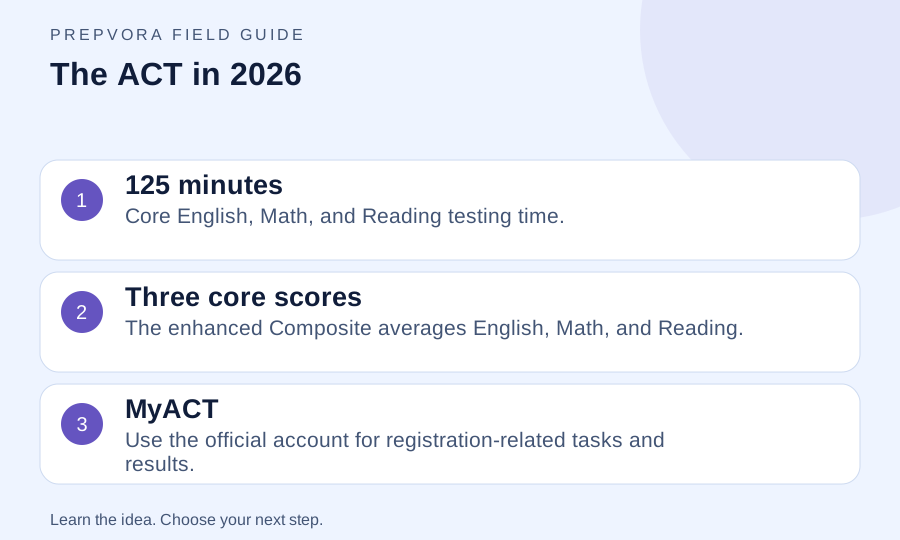
The ACT in 2026 at a glance
A map of this article. Follow the ideas in order, or revisit the one you need.
125 minutes
Core English, Math, and Reading testing time.
Three core scores
The enhanced Composite averages English, Math, and Reading.
MyACT
Use the official account for registration-related tasks and results.
Sources & further reading
AI overview
The useful ideas to take with you.
- Use the enhanced ACT format when choosing practice materials.
- The current Composite uses English, Math, and Reading; school Science arrangements may differ.
- Use MyACT for official results and compare exams under similar practice conditions.
AI-assisted summary, saved with this article. Use the full guide for context. Confirm current exam and college policies with the official source.
Find your next step.
A diagnostic helps you identify where to focus your practice.