
The short answer is 2 hours and 14 minutes of standard testing, plus a 10-minute break. The useful answer is a little broader: your morning also includes travel, check-in, instructions, and dismissal. Knowing both timelines helps you plan the day without confusing the test clock with the time you will be away from home.
SAT timing by section and module
College Board’s current timing guide gives 64 minutes for Reading and Writing and 70 minutes for Math. Each section has two equal-length modules. The scheduled break sits between the two sections.
| Part | Questions | Standard time |
|---|---|---|
| Reading and Writing, module 1 | 27 | 32 minutes |
| Reading and Writing, module 2 | 27 | 32 minutes |
| Scheduled break | — | 10 minutes |
| Math, module 1 | 22 | 35 minutes |
| Math, module 2 | 22 | 35 minutes |
The testing minutes add to 134. With the scheduled break, the sequence takes 144 minutes. This table describes standard timing; approved accommodations can change the schedule. Follow your own testing instructions when they differ.
How long will you be at the test center?
College Board’s sample Saturday schedule lists check-in around 7:45 a.m., testing starting around 8:15–8:30 a.m., and standard-time testing ending around 10:45–11 a.m. Your admission ticket controls your arrival time, and local circumstances can change the schedule. A College Board loaned device requires an earlier arrival.
For planning, separate three blocks: arrival and setup, timed testing and the break, and dismissal and pickup. A family member should not infer an exact pickup time by adding 144 minutes to the time you leave home. Traffic and the test center’s setup process are outside that calculation.
Make the plan flexible enough for an ordinary delay. If you have work, a flight, or another important commitment afterward, leave a buffer instead of treating the sample schedule as an appointment guarantee. School-day testing can follow a different local schedule, so ask your school for its instructions.
Average time per question is not a countdown for every question
Dividing 64 minutes by 54 Reading and Writing questions gives about 71 seconds per question. Dividing 70 minutes by 44 Math questions gives about 95 seconds. These averages describe the section; they do not mean every question should take the same amount of time.
A short grammar decision may take much less time than a passage requiring careful comparison. A familiar equation may be quick, while interpreting a diagram can take longer. Efficient pacing allows those differences without letting one problem consume the time needed for several others.
In practice, record unusually slow questions along with wrong answers. An answer can be correct and still reveal an inefficient method. Review whether you spent time understanding the problem, choosing a method, performing calculations, or checking work. Those are different bottlenecks.
Build checkpoints from your own practice
Start with a fresh timed module. Note where you are around its midpoint and how many questions remain near the end. Afterward, identify where time accumulated. Were you rereading every choice repeatedly, rewriting unnecessary information, or staying with a problem after you had run out of ideas?
Then test one adjustment at a time. For example, use the review flag when a question needs a fresh look, or write the quantity being requested before starting algebra. A plan becomes useful when you can observe whether it changes your decisions under realistic timing.
Avoid a rigid rule such as “leave every question after exactly one minute.” It can force you away from a nearly finished problem while still failing to address why other questions are slow. Use elapsed time as information, alongside how much progress you are making.
What the module boundary means for review
You can move among questions within the current module, but once you leave it, you cannot return to it. That makes the final review period a module-level task. Do not plan to revisit Reading and Writing questions during Math or to finish module 1 during module 2.
Practice a brief closing check: confirm that your intended answers are entered, revisit flagged questions in a deliberate order, and look for a misread instruction or unit. A review list should guide attention instead of becoming a reason to rush through everything a second time.
The test adapts between modules. A question that feels difficult does not reveal your final score. While the clock is running, focus on the current task rather than trying to diagnose which route you received.
Use the break to reset
Plan your break before test day. Follow the proctor’s instructions, keep track of when to return, and use the time for ordinary needs such as water or a snack. A rehearsal with the scheduled break can show whether you need to adjust breakfast, hydration, or your routine.
Do not spend the whole break mentally litigating a question you cannot reopen. Pick a simple reset cue: relax your shoulders, breathe normally, and remind yourself that the next section is a fresh set of tasks. This is a practical routine, not a claim that a particular technique guarantees better performance.
A rehearsal that makes the timing real
Use an official Bluebook practice test on the device you expect to use. Begin at roughly the planned time of day, follow the standard schedule appropriate for you, and avoid pausing for messages. Put a review session on your calendar before starting the test.
After the rehearsal, write down three observations: whether you finished each module, which types of questions consumed extra time, and how your focus changed across the morning. Your next study session should address one of those observations, rather than simply repeating a full test.
Common SAT timing questions
Is the SAT three hours long?
The standard digital testing time is shorter than three hours, but the full appointment includes administrative time. Older paper-test schedules are not the right reference for the current format.
Can I finish a module early and use the extra time later?
Do not plan on transferring unused time between modules. Treat each module as its own timed task and follow Bluebook’s navigation rules.
What should I prepare next?
Read the SAT test-day checklist, confirm your admission details, and use the practice-review guide to turn your next timed attempt into useful feedback.
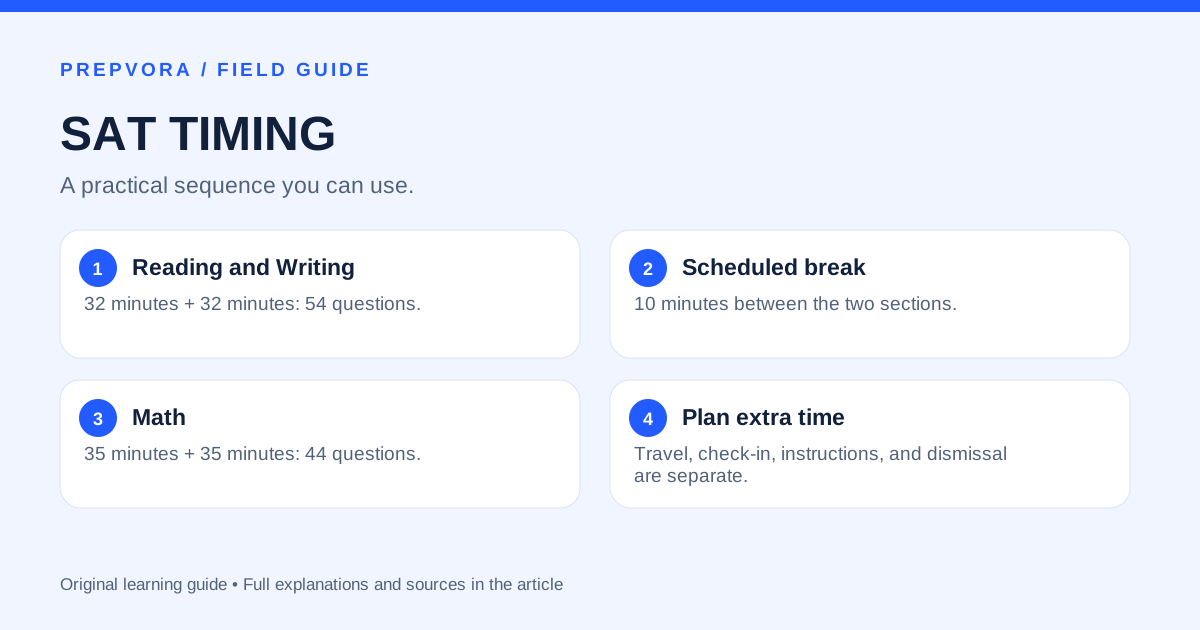
The standard SAT timing sequence
A map of this article. Follow the ideas in order, or revisit the one you need.
Reading and Writing
32 minutes + 32 minutes: 54 questions.
Scheduled break
10 minutes between the two sections.
Math
35 minutes + 35 minutes: 44 questions.
Plan extra time
Travel, check-in, instructions, and dismissal are separate.
Sources & further reading
AI overview
The useful ideas to take with you.
- Standard testing takes 134 minutes; the scheduled break brings the testing sequence to 144 minutes.
- Check-in and dismissal add time, and your admission ticket—not a generic timeline—sets your arrival instructions.
- Use timed practice to identify bottlenecks; average seconds per question is not a rigid question-by-question limit.
AI-assisted summary, saved with this article. Use the full guide for context. Confirm current exam and college policies with the official source.
Find your next step.
A diagnostic helps you identify where to focus your practice.